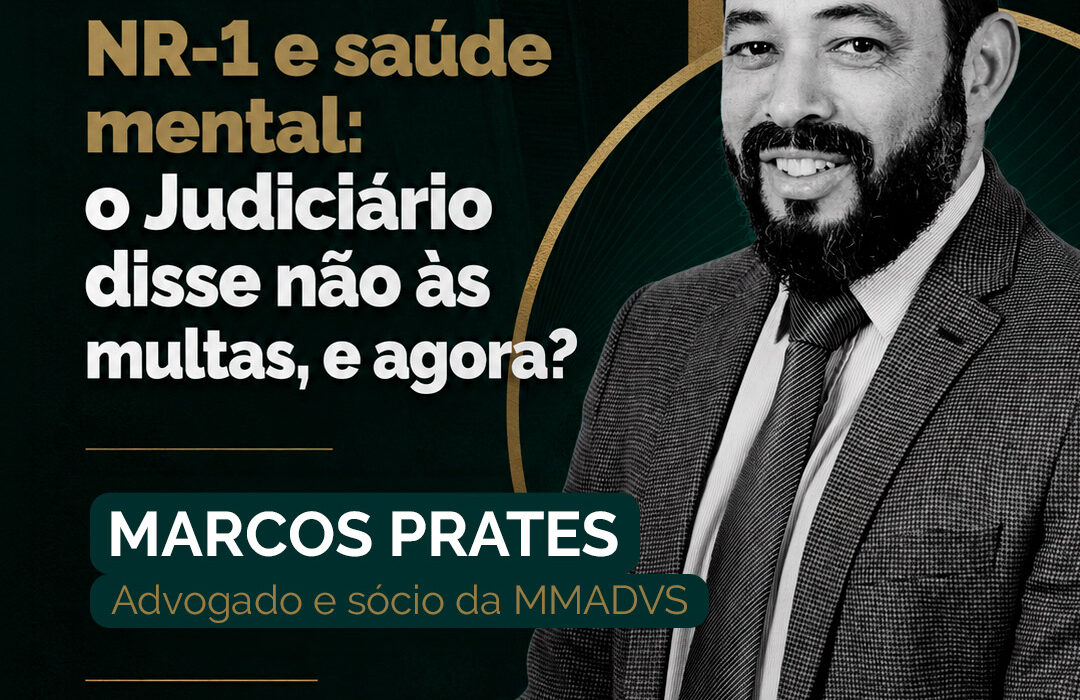
By Marcos Aurélio da Silva Prates
Attorney and partner at Martins Miguel Sociedade de Lawyers. Master Master's Degree in Law Professional in Law and Development from FGVDireito SP.
Within a few weeks, two court rulings from different courts reached the same Conclusion: Until the Ministry of Labor and Employment establishes clear criteria regarding what constitutes psychosocial risks and how companies should address them, no employer may be cited, fined, or shut down based on these provisions of NR-1.
The first was handed down by the TRF3 in June 2026, in a lawsuit filed by FIESP and São Paulo industry unions. The second ruling came from the STF, in an ADPF filed by CONFENEN—the National Confederation of Educational Institutions. Together, they constitute the most significant legal precedent to date regarding MTE Ordinance No. 1,419/2024.
The problem that both decisions recognized
The standard requires companies to identify and manage psychosocial risk factors in the workplace—but the Ministry of Labor itself has admitted, in its guides and manuals, that it does not specify any particular tool or methodology for doing so.
The result is a deadlock: the company doesn't know exactly what it needs to do, the inspector has no objective criteria for assessing compliance, and yet the threat of Punishment exists. Both rulings rejected that logic. It is not possible to punish someone for violating a rule that the State itself cannot clearly define.
In addition, the TRF3 identified another problem: the regulation was issued without the Ministry having first conducted the economic impact study required by law. The term “psychosocial risk factors” simply was not included in the text that was the public consultation in 2023 — it appeared in the final version of the ordinance without going through the mandatory regulatory process.
What Changes—and What Doesn't—for Each Company
The two decisions have important differences that directly affect who is and who is not protected.
The STF's decision has nationwide applicability: it applies to all employers in the country. The TRF3's decision protects only companies in the São Paulo manufacturing sector represented by FIESP and by the
the plaintiff unions. A company in the service or retail sector, for example, is not covered by the TRF3 ruling—but is likely covered by the STF ruling.
Another important point: the STF’s decision is time-limited. Justice André Mendonça set a 90-day deadline for the government and the entities to attempt to reach an agreement—with mediation by the Supreme Court itself—to reformulate the rule with clearer criteria. If an agreement is reached, the rule will go back into effect—in a more objective form. If not, the STF will rule on the merits of the case. The TRF3’s decision, meanwhile, has no set deadline.
The STF also took a broader approach to the suspended provisions, including provisions regarding the choice of methodology and documentation that the TRF3 did not address.
In both cases, the rule remains in effect as a guideline. What has been suspended is only the possibility of disciplinary action—not the obligation to address mental health in the workplace.
Why Judicial Protection Is Not Enough
It would be a mistake to interpret these decisions as a green light to do nothing. The protection is temporary, conditional, and does not cover all risks.
Fines have been suspended—but the FAP has not. If an employee takes leave due to a mental health condition and the incident is classified as an occupational illness, this information is factored into the calculation of the Accident Prevention Factor and may increase the company’s social security costs based on its payroll. No court ruling has changed this.
Labor-related liabilities also remain. A company that fails to document any measures for the prevention of psychosocial risks may be held liable in an individual lawsuit even if the administrative penalty has been suspended.
And if the regulation is revised during the NUSOL period—which is a real possibility—a company that has not prepared its preventive documentation will be unprepared for the new version, which may include clearer criteria and, therefore, carry greater penalties.
What to Do Now
Now is the time to prepare, not to wait. Three areas deserve our simultaneous attention.
In the legal arena, companies and industry associations that do not yet have legal protection should consider filing their own lawsuit or joining a class-action lawsuit. This legal argument has already been upheld in two courts, and the evidence is primarily documentary.
In the operational field, it is advisable to update the PGR to recognize psychosocial risks within the existing ergonomics framework—without adopting a formal methodology while the enforcement standard remains suspended—and to document the preventive measures already in place: workplace climate surveys, whistleblower channels, work hours monitoring, and goal management.
In the area of social security, now is the time to review the FAP, determine whether there are any mental health conditions classified as occupational diseases that have no actual connection to the company’s activities, and assess the possibility of filing an administrative appeal.
What Lies Ahead
The Supreme Federal Court (STF) gave the government a 90-day window to correct the problem identified by the judiciary: a rule that imposes an obligation but does not define what must be done to comply with it. If the Ministry of Labor takes advantage of this window and presents clear, objective, and proportionate criteria, the regulation will be reinstated on a more solid foundation. If it fails to do so, the judicial outcome is likely to be even more favorable to companies.
In any case, the debate over mental health in the workplace isn’t going away. The data is striking: more than 546 mil absences due to mental health disorders in 2025, and a 134% increase in social security benefits for mental health in the previous two-year period. The problem is real and demands a response—but one that employers can understand, comply with, and document.
That is what the judiciary demanded. And that is what companies need to demand from the regulator
References
BRAZIL. TRF3. ACP Part No. SO146S6-74.2026.4.03.6100.Decision of the Federal Court of Appeals, June 2026. Federal Judge Cristiane Farias Rodrigues dos Santos.
BRAZIL. Supreme Federal Court. ADPF nO 131b. Interim Ruling by Justice André Mendonça, 2026.
BRAZIL. Ministry of Social Security. 546.254 benefits for mental health conditions in 2025. Jan. 2026.
UNITED NATIONS BRAZIL. Suspensions due to health mental health issues are on the rise 134% in Brazil. Apr.
2025.
Mark Aurélio da Silva Prates — marcos@mmadvs.com — Attorney e partner of Martins Miguel Society Lawyers' Association, São São Paulo, SP. Master's Degree in Law — f’GVDireito SP. Legal Expert Audience — EPD/SP